
The Horse Boy

By: Rupert Isaacson
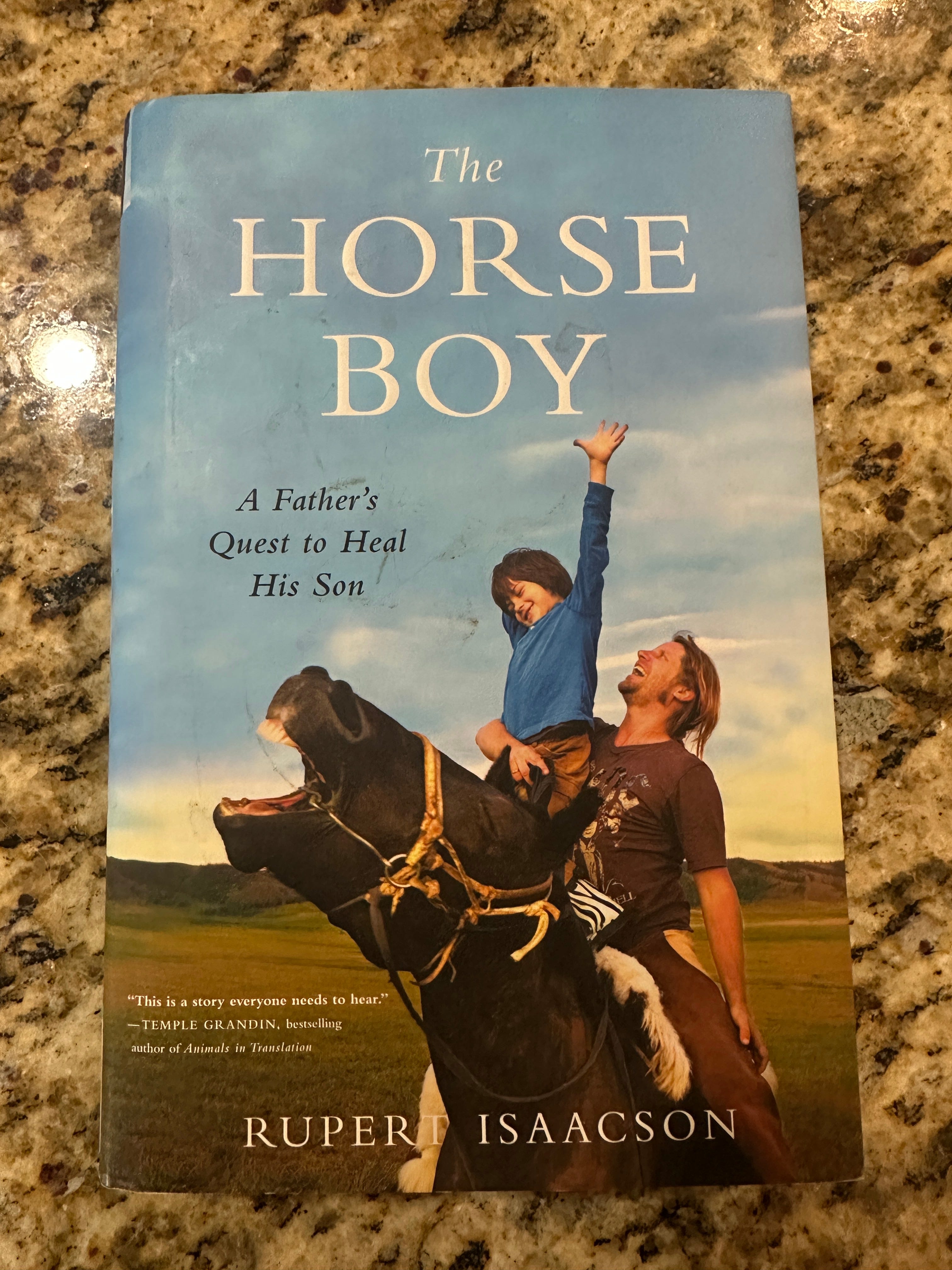
This true story is touching, beautiful, dramatic and at times a bit bizarre. Rowan’s family journey across outer Mongolia is one of love and desperation to help heal him of his dysfunctional autistic behaviors. In the epilogue, Dr. Baron-Cohen is quoted as saying, “Perhaps in the future, it is going to be increasingly controversial whether autism is something that needs to be cured or not. Perhaps it is more a personality type.”
“Like all new parents, we projected our own dreams and desires onto our kid, and projected hard.” p12
“I don't know quite how I had pictured our arrival in Mongolia. Straight off the plane and onto the steppe, I guess, with comparisoned horses waiting for us just beyond the baggage claim, smiling nomads cheering us, shamans dancing and drumming, eagles circling in the sky, the horses, cattle, sheep, goats, and yaks doing some kind of Broadway number in the background and the wolves and bears of the mountain accompanying on sax and trombone. “ p77
“The road began as tarmac, a straight black ribbon running westward over the grass. Then it became… well, not a road. Target gave away the dirt, which gave way - and this was a major highway, remember - to a series of strange, parallel, almost random tracks torn into the great muddy landscape like scars and gouges left by the passage of some giant beast. Rain squalls came and went. The gears of the van ground loudly, the interior swung wildly, with us in it, like traveling inside a cement, mixer, killing conversation. But outside the window was a scene that was utterly timeless.” p115
“The pines were small, slender, perhaps fifteen or so feet high, feminine looking, like dancing maidens with their rich greenswards strewn with flowers.” p194
“I stood in the last of the great, continent-sized meadow that is the steppe and gazed at the forest wall. It was like facing an army. An ancient army. Its charge, its presence, was palpable. The sound of the wind in the trees was like the sighing of God's breath.” p237
“At last, in the dying light, the sky streaked with sunset, they came marching back from their game, four of them all hand-in-hand, swinging their arms in unison, singing some song that only children, who know the common language of children, understand.” p326
“Why can't he exist between the worlds, with a foot in both, as many neurotypical people do? Think of immigrants to the United States, living with one foot in their home language and culture, the other in the West, walking in two worlds. It is a rich place to be. Can Rowan keep learning the skills necessary to swim in our world while retaining the magic of his own? It seems a tangible dream. “ p349